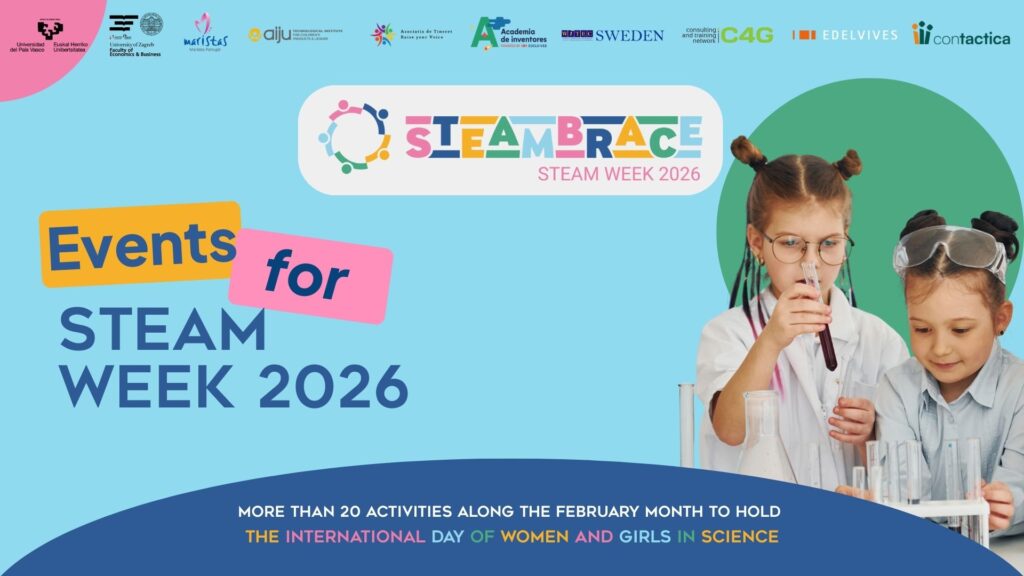
STEAM Week is bringing together partners from across Europe throughout February to celebrate the International Day of Women and Girls in Science with a diverse programme of educational, scientific, and community-focused activities.
With more than 20 events organised in multiple countries, the initiative highlights the shared commitment of the STEAMbrace consortium to promote inclusive STEAM education, empower young people, especially girls, and foster future skills for a rapidly changing world.
A Europe-wide programme of hands-on learning and inspiration
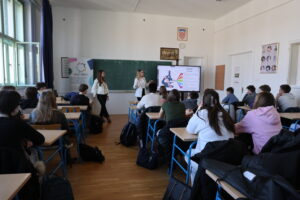
Across universities, schools, museums, libraries, and innovation centres, STEAM Week activities are designed to engage students through interactive and experiential learning.
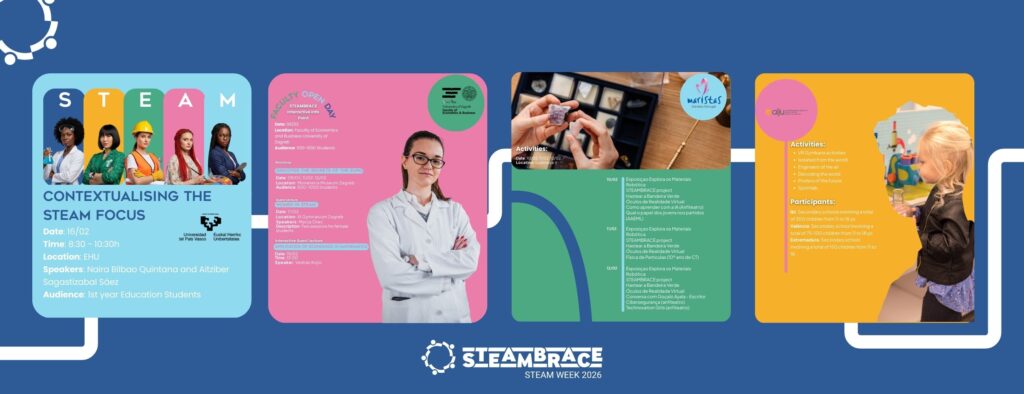
Formative sessions, such as the contextualisation of the STEAM approach for education students at the University of the Basque Country (EHU), explore how interdisciplinary teaching can shape future classrooms and learning environments.
The Faculty of Economics and Business of the University of Zagreb, will have workshops, guest lectures, and faculty open-day initiatives introduce hundreds of students to topics ranging from the economics of mathematics to the role of women in STEAM careers, reinforcing both academic curiosity and gender equality.
Meanwhile, our partners in Portugal, Colegio Maristas Compostela, are hosting multi-day programmes featuring robotics, virtual reality, artificial intelligence, cybersecurity, and youth engagement activities, demonstrating the breadth of STEAM disciplines and their relevance to everyday life.
Engaging young learners through creativity, technology, and experimentation
Several STEAM Week initiatives focus specifically on active participation and experimentation. One of our spanish partners, AIJU, has prepared interactive learning experiences such as VR gymkhanas, engineering challenges, creative poster design, and sprint-style innovation labs are engaging secondary-school students across Spanish regions including València, Ibi, and Extremadura, reaching hundreds of young participants aged 11 to 18.
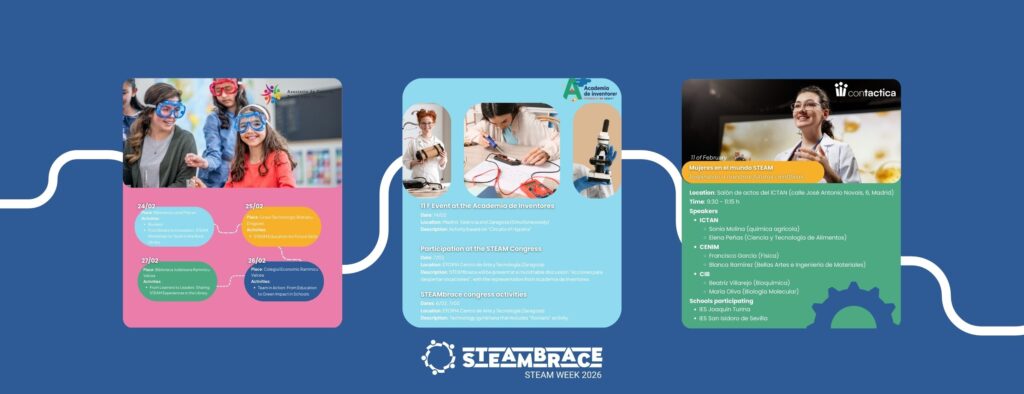
In Romania, Asociatia de Tineret Raise Your Voice, will have workshops in libraries and schools connect science education with leadership, sustainability, and green impact in local communities, showing how STEAM learning can extend beyond classrooms into civic life.
These activities collectively demonstrate how STEAM Week supports not only knowledge acquisition but also creativity, collaboration, and social responsibility.
Celebrating Women and Girls in Science at the heart of STEAM Week
A central milestone of STEAM Week is the celebration of the 11 February International Day of Women and Girls in Science, marked by events across several European cities.
Highlights include educational circuits and technology-focused activities organised by the Academia de Inventores, as well as round-table discussions and technology gymkhanas hosted at Zaragoza’s ETOPIA Centre for Art and Technology, all aimed at awakening scientific vocations among young audiences.
The week also features the event organized by Contactica, “Women in the STEAM World: Inspiring our Future Scientists” in Madrid, where researchers from ICTAN, CENIM, and CIB share their professional journeys with participating schools, offering visible role models and reinforcing gender equality in scientific careers.
Opening honest conversations on STEAM vocations in Zaragoza
As part of STEAM Week, partners are also fostering critical dialogue around STEAM vocations through the event “Dialogues: STEAM Vocations – what no one tells you,” organised in Zaragoza.
Taking place on 10 February at the Casa de la Mujer, the round-table discussion brings together voices from the scientific, technological, and business sectors to reflect on the real challenges, invisible barriers, and social perceptions that shape participation in STEAM pathways.
Moderated by Beatriz Giner Parache, the conversation features contributions from Esther Borao Moros, Manuela Delgado Cruz, Rosa Monge Prieto, and José Manuel López Sebastián, offering diverse professional perspectives on how to build more inclusive, realistic, and accessible STEAM vocations.
The event is opened by María Jesús Lázaro Elorri and Ana Gaspar Cabrero, and dynamically supported by the VALPAT STEAM Channel, reinforcing collaboration between educational, institutional, and societal stakeholders.
Organised with the involvement of Grupo Edelvives, AMIT Aragón, CSIC Aragón, STEAMbrace, the Spanish Ministry of Science, Innovation and Universities, and the City Council of Zaragoza, this initiative highlights how STEAM Week extends beyond educational activities to include reflection, dialogue, and systemic change in the promotion of STEAM careers.
Strengthening inclusive STEAM education across Europe
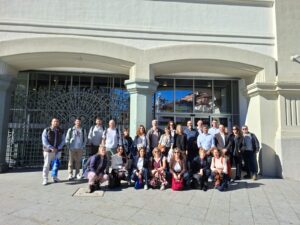
Through this coordinated European effort, STEAM Week illustrates the power of collaboration between educational institutions, research centres, and community organisations.
By combining hands-on experimentation, inspirational role models, and interdisciplinary learning, the STEAMbrace partners are helping shape more inclusive pathways into science, technology, engineering, arts, and mathematics, ensuring that future generations are equipped with the skills and confidence needed to address societal challenges.
As activities continue throughout February, STEAM Week stands as a shared European commitment to education, equality, and innovation—bringing science closer to young people and empowering the scientists, engineers, and creators of tomorrow.