Women in STEM Awards: Celebrating Global Excellence in 2026

When conversations turn to women in Science, Technology, Engineering, and Mathematics, the gender gap and underrepresentation often dominate the narrative. While these challenges remain relevant, Women in STEM awards continue to show a more complete picture—one of progress, excellence, and global impact. In 2026, recognition of women’s achievements across STEM fields is no longer an exception. Prestigious international awards increasingly reflect the reality that women are shaping medicine, artificial intelligence, engineering, and mathematics at the highest level. This article highlights major, globally competitive awards open to all researchers. By focusing on these honours, we underscore the scale and significance of the contributions women in STEM and every discipline it covers. Women in STEM awards in medicine: decoding the human body Some of the most influential medical breakthroughs recognised in recent years belong to women scientists. A landmark moment came with the Nobel Prize in Physiology or Medicine awarded to Mary Brunkow and her team for redefining how autoimmune diseases can be treated. Her work made it possible to selectively deactivate specific immune responses, avoiding the widespread suppression of the immune system that once defined treatment. Recognition continued with the Breakthrough Prize in Life Sciences, where Lotte Bjerre Knudsen and Svetlana Mojsov were honoured for decades of foundational research on the GLP-1 hormone. Their work laid the groundwork for therapies that are now transforming diabetes, obesity, and cardiovascular care worldwide. Germany’s prestigious Leibniz Prize also reflected this momentum. Among the recipients, Maria-Elena Torres-Padilla was recognised for advancing understanding of cell plasticity in early embryo development. Ana Pombo was awarded for pioneering genomic techniques that reveal how DNA’s three-dimensional structure influences gene regulation and disease. Bettina Valeska Lotsch received the prize for developing highly efficient photocatalysts, a key component in next-generation solar energy storage. A true testament of how women in STEM contribute to today’s society. Teaching machines to think: Women leading AI innovation Artificial intelligence continues to define this decade, and women are shaping its most human-centred applications. Cordelia Schmid received the inaugural Archimedes Science Award for her work enabling computers to interpret visual data—technology that now underpins safety systems, image recognition, and autonomous mobility. The Lovelace Medal, awarded by the British Computer Society, went to Mirella Lapata for transforming how machines generate and understand human-like narratives from text and structured data. Regina Barzilay, a Moldovan-born researcher at MIT, was recognised with the IEEE Frances E. Allen Medal. Her AI-driven models for predicting breast and lung cancer risk demonstrate how machine learning can save lives, not merely automate processes. Engineering a sustainable future Among the most visible Women in STEM awards, engineering prizes show how innovation translates into real-world impact. The Queen Elizabeth Prize for Engineering honoured Fei-Fei Li for creating ImageNet, the dataset that accelerated breakthroughs in computer vision and deep learning. At the European level, Marie Perrin received the World Builders Prize at the EPO Young Inventors Awards for her rare-earth recycling technology. Her solution enables the recovery of europium from discarded fluorescent lamps while capturing toxic mercury and reducing mining dependency. Jessica Day and her team at OrganOx secured the MacRobert Award for developing a system that keeps donated livers viable outside the human body, dramatically improving transplant success rates. Meanwhile, roboticist Daniela Rus was awarded the IEEE Edison Medal for her work on collaborative robot networks designed for manufacturing and rescue missions. Women in STEM awards and the power of mathematics Mathematics remains the hidden language behind many scientific advances. Hong Wang received the Ostrowski Prize for her work in harmonic analysis, addressing long-standing challenges such as the Kakeya conjecture. The Blaise Pascal Medal was awarded to Svitlana Mayboroda for mathematical theories explaining wave behaviour in complex materials. The London Mathematical Society also recognised multiple women, including Helen Byrne, Henna Koivusalo, Perla Sousi, and Ewelina Zatorska, for contributions ranging from tumour modelling to probability theory and fluid dynamics. Angkana Rüland, another Leibniz Prize recipient, was recognised for mathematical analysis applied to crystalline structures and advanced medical imaging. Why visibility matters for the next generation Celebrating Women in STEM awards is not only about recognition—it is about visibility. Role models such as Mary Brunkow, Fei-Fei Li, and Daniela Rus make scientific careers tangible for younger generations. Seeing women succeed at the highest level helps dismantle stereotypes and expand aspirations. STEAM education as a path forward Sustained progress requires early support. This is where initiatives like STEAMbrace play a critical role for Women in STEM. By integrating the Arts into STEM education, STEAMbrace promotes creativity, collaboration, and problem-solving—skills that underpin many award-winning careers. Through challenges like menteSTEAM, students move beyond passive learning and engage directly with real-world problems such as pollution and climate change. The initiative offers a powerful incentive: the winning secondary school team will represent Spain at the European STEAMbrace Contest in 2026. Recognition that builds the future Women in STEM awards highlight excellence, but their broader value lies in inspiration. They signal to students, educators, and institutions that innovation thrives through diversity. As education systems continue to evolve, recognising women’s achievements remains essential to building a more inclusive and resilient scientific future. By combining visibility, education, and opportunity, projects like STEAMbrace help ensure that today’s students become tomorrow’s award-winning innovators.
International Collaboration in STEAM Education: Connecting Classrooms Worldwide

International collaboration is transforming STEAM education by bringing students, teachers, and institutions together across borders, and at STEAMbrace, we want to share the knowledge with you! When young people connect beyond their own countries, they gain new ways of thinking, learn how to work with others, and tackle global problems with creative teamwork. In a world where science, technology, engineering, arts and mathematics are key to progress, collaborations that span continents are becoming an essential part of learning. What Is International Collaboration in STEAM Education? In simple terms, international collaboration in STEAM education means students working with peers from other countries on shared scientific, artistic, or technological projects. Instead of learning in isolation, they use digital tools to co-create solutions to real-world challenges. This style of learning helps develop a mindset of global citizenship and encourages respect for different ideas and cultures. Digital platforms such as eTwinning, Global Lab, and Zoom are making these partnerships easier than ever. Through them, students from Europe can connect with peers in Asia, Africa, or the Americas to exchange ideas, ask questions, and design projects; even if they never meet in person. As a result, STEAM education becomes not just a learning approach, but a bridge between cultures. Why Does International Collaboration Matter? Global projects in STEAM education help students build crucial 21st-century skills while building empathy and curiosity about the world. Whether taking part in a hackathon on climate change or creating a shared digital artwork, learners enrich their understanding of both science and humanity. Key benefits of this approach include: Cross-cultural communication: Learning to express ideas and listen respectfully to diverse perspectives. Real-world problem solving: Tackling issues such as sustainability, healthcare, or accessibility alongside peers abroad. Digital literacy: Gaining confidence in using online tools to research, create, and present ideas. These experiences help young people see that creative, inclusive solutions rarely come from a single perspective. Instead, they emerge through shared effort, which is an essential mindset in today’s globalised workforce. Real Examples of International Collaboration in STEAM Successful global collaborations already exist. For instance, international hackathons bring teenagers together to design eco-friendly technologies or propose digital solutions to societal problems. Research exchanges and virtual competitions also give students the chance to learn from cutting-edge innovations taking place worldwide. Platforms like eTwinning provide tools and forums to help teachers launch collaborative STEAM projects between schools in different countries. A class in Spain might partner with one in Poland to design a prototype for a sustainable city. Or pupils in Croatia could work with learners in Portugal to create a robotics challenge, sharing data, videos and drawings online, then voting together on the best designs. Participation in international science fairs, artistic tech exhibitions, or coding competitions helps students access new ideas, feel inspired and, importantly, see themselves reflected in the global STEAM community. Many return home not only with improved skills, but with long-term connections that support future study or professional ambitions. Building Equity and Global Mindsets International collaboration in STEAM education is not only about academic growth: it also plays a role in promoting inclusion and equity. By connecting students from different socio-economic backgrounds, regions and cultures, it offers access to wider resources and perspectives. This creates a fairer, more balanced learning environment, especially for students who may not otherwise have opportunities to engage globally. Moreover, mixed-gender and diverse group work helps break stereotypes and generate more inclusive creative thinking. These collaborations can encourage girls and underrepresented learners to see STEAM fields as welcoming and exciting, boosting participation and confidence. Looking Ahead: A More Connected Future As global challenges become increasingly complex, the need for creative, connected problem-solvers will only grow. International collaboration in STEAM education prepares young people not just to understand their world, but to improve it. By working across cultures with shared goals, students learn that curiosity has no borders and innovation is strongest when built together.
Sustainable STEAM education: impact on STEAMbrace’s future
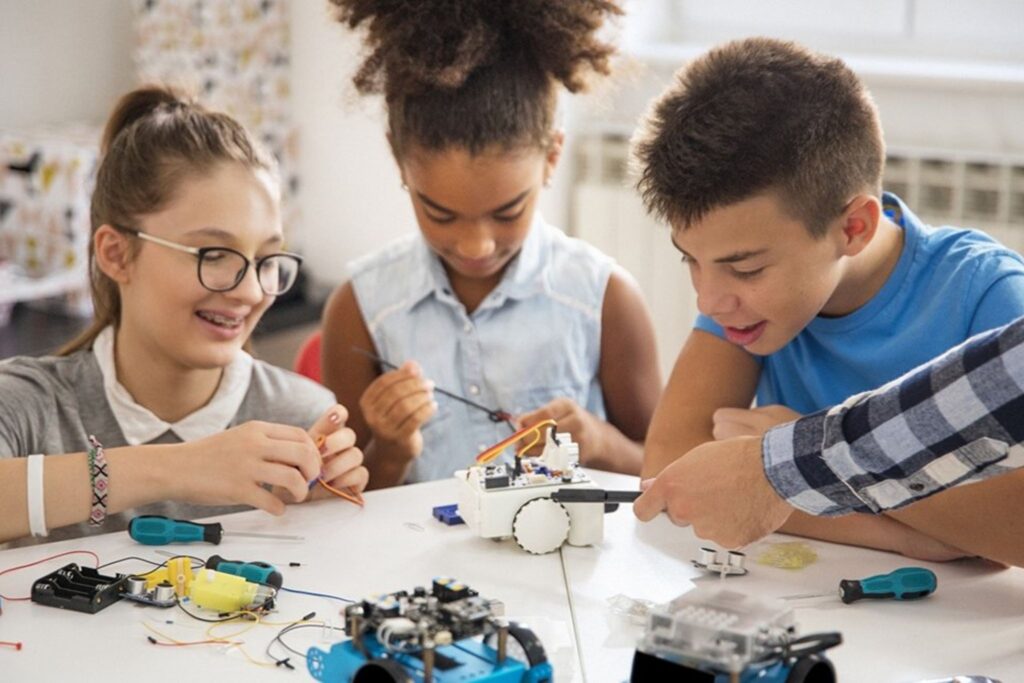
We are on the constant push for change in education. Our focus lies in sustainable STEAM education. We aim to close the gender gap in STEM. We integrate arts with science, technology, engineering, and math. We empower learners to create eco-friendly solutions. Our mission drives us to build bridges among diverse experts. With sustainable STEAM education, we prepare future innovators to tackle environmental challenges. Our new STEAMbrace HQ in Zaragoza reinforces our vision. It serves as a central hub for collaboration and growth. The Power of Sustainable STEAM Education Our approach changes lives. We prepare teachers to use active methods every day. Students engage in hands-on experiments. They build models and test ideas. They learn to solve real problems with clear purpose. This method inspires confidence in young minds. It also sparks curiosity about nature. In our classrooms, learners work on renewable energy projects. They design eco-friendly systems. Moreover, this approach teaches ethical skills. It prepares them for green careers. Our focus on sustainable STEAM education brings real change to education. It makes learning engaging and practical. Shaping Projects through Creative Collaboration At STEAMbrace, we drive innovation in every workshop. We exchange ideas and develop new strategies. We plan training sessions and build digital resource hubs. Our partners include experts from many fields. They bring creative techniques to our table. They use evidence-based methods to shape projects. Our innovative projects exemplify sustainable STEAM education in action. We design methods that work in real life. We ensure every activity is practical and inspiring. Collaboration remains at the heart of our approach. Building a better and more inclusive future We believe in a greener future. Our vision centers on sustainability as a core value. We promote eco-friendly practices in every lesson. We promote sustainable STEAM education practices in every lesson. Students explore green technology and sustainable design. Teachers introduce interactive labs and digital tools. They run experiments that use real data. Learners develop a deep respect for the environment. They learn to balance innovation with nature. Moreover, our methods foster responsibility. We encourage every participant to think globally. Our vision creates lasting community impact. We build strong networks and share best practices. This work opens new career paths. It drives a culture of eco-friendly creativity and collaboration. Furthermore, our work fosters innovation. We support research that improves green practices. We share our findings with partners and communities. We encourage educators to adopt these methods. This shared effort builds a robust network. It ensures that eco-friendly ideas spread quickly. We believe small actions lead to big impacts. Our community grows stronger with every new idea. Conclusion In conclusion, our journey relies on STEAM and sustainability. Our approach transforms learning and inspires innovative solutions. We empower students and teachers to face real-world challenges. Our new headquarters in Zaragoza acts as a beacon for progress. Our project stands as proof that education can change the world. We drive change by combining creative methods with ethical practices. We embrace STEAM and sustainability to build a brighter, inclusive future. Join us as we continue to explore new ideas and methods. Together, we create a greener and more innovative tomorrow. We firmly believe that embracing sustainable STEAM education will shape a better world.