STEAM Week mobilises a European ecosystem for inclusive and innovative education
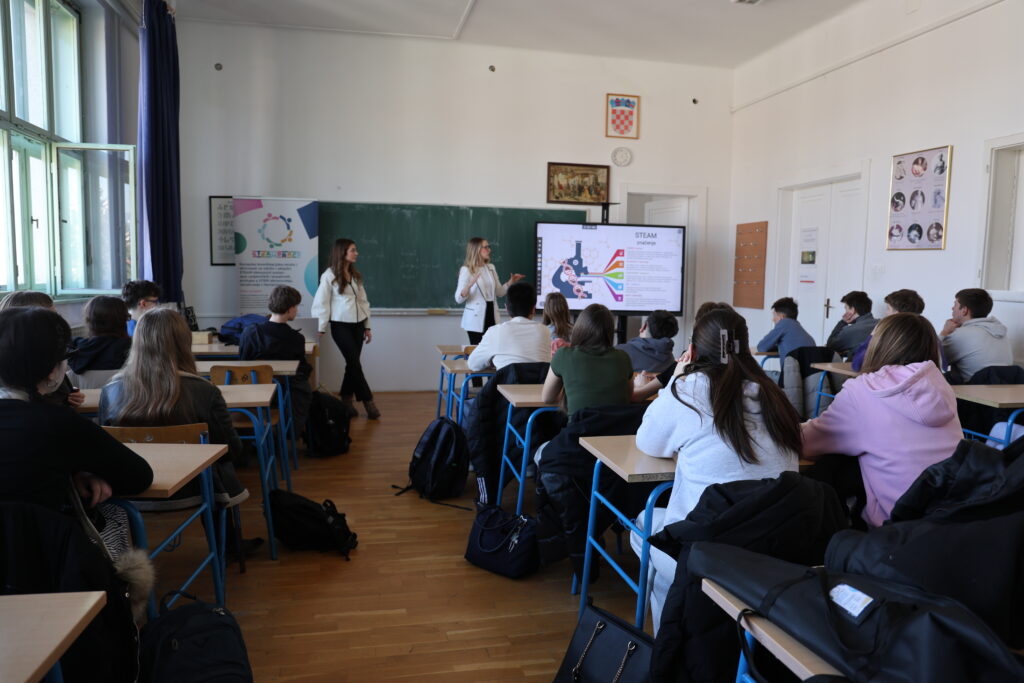
STEAM Week has emerged as a powerful collective milestone for the STEAMbrace project, bringing together schools, universities, research centres, libraries, families, and public institutions across Europe under a shared mission: advancing inclusive, interdisciplinary, and future-oriented STEAM education. Across multiple countries and educational levels, partners of the STEAMbrace consortium implemented a diverse and ambitious programme of activities that engaged thousands of students and educators. From university teacher training to hands-on workshops, from public conferences to national competitions, STEAM Week demonstrated how coordinated action can transform educational practices and generate meaningful societal impact. More than a thematic celebration, STEAM Week functioned as a living laboratory of what STEAM education can look like when implemented collaboratively, inclusively, and with a strong European dimension. From teacher education to school transformation One of the most strategic contributions came from the University of the Basque Country (EHU), where first-year Education students participated in a formative session contextualising the STEAM approach within initial teacher education. Delivered within the Didactics curriculum, the session traced the evolution from STEM to STEAM, analysed its theoretical foundations, and aligned the methodology with national competence frameworks. STEAMbrace was presented as a practical case study of systemic change toward more equitable and inclusive education. By embedding STEAM within teacher training, the initiative extended its impact beyond a single event: future educators are now designing their own STEAM-based learning projects, grounded in real-world problem solving and the Sustainable Development Goals. In Croatia, the University of Zagreb’s Faculty of Economics and Business, in collaboration with the Moneterra Museum, expanded STEAM Week beyond the classroom. Through the interactive workshop “Discover the Secrets of the Euro,” secondary students explored the European banking system, euro banknote production, and advanced anti-counterfeiting technologies. By designing their own banknotes and examining material science innovations, students experienced how science, economics, and technology intersect in everyday life. This experiential model reinforces a key message of STEAMbrace: innovation becomes meaningful when students understand its relevance beyond textbooks. Engaging young minds across regions In Spain, AIJU implemented immersive VR gymkhana activities across Ibi, Valencia, and Extremadura, engaging hundreds of students aged 11 to 18. These hands-on experiences fostered digital skills, creativity, and collaborative problem solving—key competencies for future innovators. In Portugal, MPT organised multi-day educational activities integrating robotics, virtual reality, artificial intelligence, cybersecurity, and sustainability themes. These sessions exemplified interdisciplinary learning, connecting technology with ethical reflection and societal challenges. Romanian partners ATRV brought STEAM into schools and libraries, reaching more than one thousand students across multiple events. Workshops such as “STEAM Education for Future Skills” and “From Education to Green Impact in Schools” demonstrated how educational institutions can act as local innovation hubs, empowering students to apply STEAM methodologies to environmental and community-based challenges. These actions highlight one of the strongest impacts of STEAM Week: its adaptability across contexts. Whether implemented in urban universities, rural libraries, or secondary schools, STEAMbrace provides a flexible framework capable of responding to local needs while maintaining European coherence. Women in Science at the core of the initiative Aligned with the International Day of Women and Girls in Science (11F), gender equality remained a central pillar of STEAM Week. In Madrid, the event lead by Contactica, “Women in STEAM: Inspiring our Future Scientists” gathered researchers from ICTAN-CSIC, CENIM, and the Centro de Investigaciones Biológicas Margarita Salas to share their professional journeys with students. By presenting visible female role models across disciplines—from molecular biology to advanced materials—the initiative reinforced the importance of representation in shaping aspirations. Similarly, in Zaragoza, sessions organised with Edelvives, AMIT Aragón, and the CSIC Delegation engaged 90 secondary students in discussions about scientific vocations, culminating in a round table at the Casa de la Mujer. These dialogues connected education, research institutions, and local government, strengthening the ecosystem supporting girls in science. By embedding gender inclusion into practical activities rather than treating it as a standalone topic, STEAM Week demonstrated how equality can be structurally integrated into STEAM education. Public engagement and European visibility STEAM Week also extended into broader public arenas. Through participation in the Congreso Nacional STEAM at Etopia in Zaragoza, STEAMbrace partners—including Academia de Inventores and Edelvives—contributed workshops, technological gymkhanas, and round tables focused on awakening scientific vocations. The presence of institutional leaders and prominent figures in science further amplified the initiative’s visibility. At national level, C4G launched the MENTES STEAM Competition in Portugal, challenging schools to submit innovative STEAM project proposals. The competition promotes creativity, critical thinking, and digital competence, with the winning secondary team representing Portugal at a European final. This initiative expands STEAM Week from a series of events into an ongoing mobilisation mechanism. Collectively, these actions generated significant visibility and positioned STEAMbrace as an active contributor to Europe’s broader educational innovation landscape. What has STEAM Week achieved? Several key conclusions emerge from this coordinated effort: Scale and Reach: Activities implemented across multiple countries engaged well over two thousand students, teachers, and families, reinforcing the project’s cross-border impact. Educational Transformation: By targeting both students and future teachers, STEAM Week strengthens systemic change rather than isolated intervention. Gender Inclusion: Women in Science was not symbolic but embedded in workshops, panels, and educational design. Experiential Learning: Hands-on activities, real-life contexts, and interdisciplinary approaches proved particularly effective in increasing engagement. European Noise: Through coordinated communication, social media amplification, and institutional collaboration, STEAM Week contributed to increasing European-level awareness of innovative STEAM methodologies. A growing European movement Beyond individual activities, STEAM Week reflects the emergence of a growing European ecosystem committed to rethinking education. The project’s ability to mobilise universities, museums, schools, libraries, research centres, families, and policy actors demonstrates the power of collaboration under the Horizon Europe framework. STEAMbrace is not only implementing activities—it is helping to shape a narrative about what inclusive, innovative, and interdisciplinary education should look like in the 21st century. As the project continues to expand its actions and partnerships, STEAM Week stands as tangible evidence that coordinated European collaboration can translate strategy into impact. The message is clear: when science, technology, engineering, arts, and mathematics converge in meaningful learning
STEAM Week connects partners across Europe to inspire the next generation in science and innovation
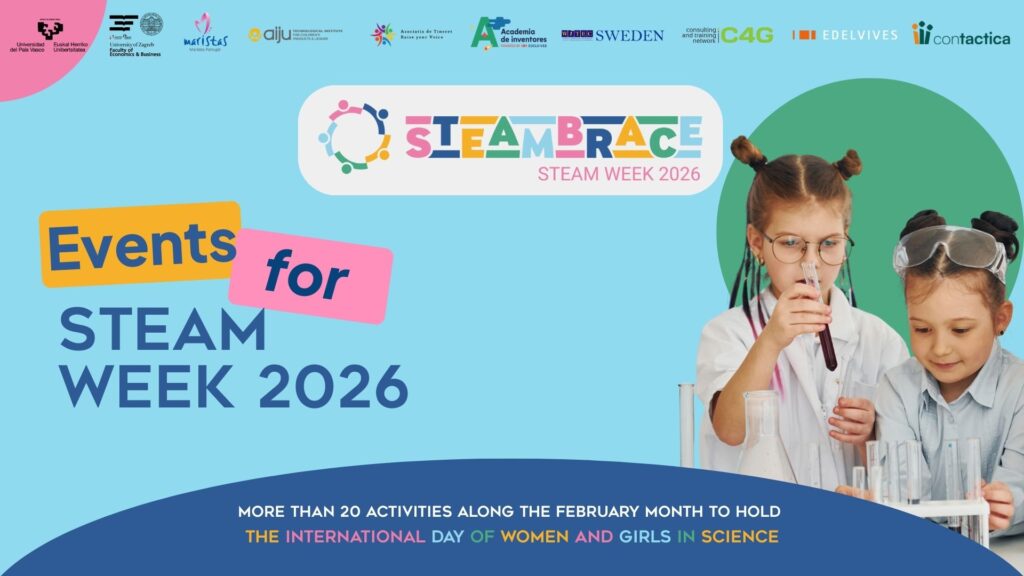
STEAM Week is bringing together partners from across Europe throughout February to celebrate the International Day of Women and Girls in Science with a diverse programme of educational, scientific, and community-focused activities. With more than 20 events organised in multiple countries, the initiative highlights the shared commitment of the STEAMbrace consortium to promote inclusive STEAM education, empower young people, especially girls, and foster future skills for a rapidly changing world. A Europe-wide programme of hands-on learning and inspiration Across universities, schools, museums, libraries, and innovation centres, STEAM Week activities are designed to engage students through interactive and experiential learning. Formative sessions, such as the contextualisation of the STEAM approach for education students at the University of the Basque Country (EHU), explore how interdisciplinary teaching can shape future classrooms and learning environments. The Faculty of Economics and Business of the University of Zagreb, will have workshops, guest lectures, and faculty open-day initiatives introduce hundreds of students to topics ranging from the economics of mathematics to the role of women in STEAM careers, reinforcing both academic curiosity and gender equality. Meanwhile, our partners in Portugal, Colegio Maristas Compostela, are hosting multi-day programmes featuring robotics, virtual reality, artificial intelligence, cybersecurity, and youth engagement activities, demonstrating the breadth of STEAM disciplines and their relevance to everyday life. Engaging young learners through creativity, technology, and experimentation Several STEAM Week initiatives focus specifically on active participation and experimentation. One of our spanish partners, AIJU, has prepared interactive learning experiences such as VR gymkhanas, engineering challenges, creative poster design, and sprint-style innovation labs are engaging secondary-school students across Spanish regions including València, Ibi, and Extremadura, reaching hundreds of young participants aged 11 to 18. In Romania, Asociatia de Tineret Raise Your Voice, will have workshops in libraries and schools connect science education with leadership, sustainability, and green impact in local communities, showing how STEAM learning can extend beyond classrooms into civic life. These activities collectively demonstrate how STEAM Week supports not only knowledge acquisition but also creativity, collaboration, and social responsibility. Celebrating Women and Girls in Science at the heart of STEAM Week A central milestone of STEAM Week is the celebration of the 11 February International Day of Women and Girls in Science, marked by events across several European cities. Highlights include educational circuits and technology-focused activities organised by the Academia de Inventores, as well as round-table discussions and technology gymkhanas hosted at Zaragoza’s ETOPIA Centre for Art and Technology, all aimed at awakening scientific vocations among young audiences. The week also features the event organized by Contactica, “Women in the STEAM World: Inspiring our Future Scientists” in Madrid, where researchers from ICTAN, CENIM, and CIB share their professional journeys with participating schools, offering visible role models and reinforcing gender equality in scientific careers. Opening honest conversations on STEAM vocations in Zaragoza As part of STEAM Week, partners are also fostering critical dialogue around STEAM vocations through the event “Dialogues: STEAM Vocations – what no one tells you,” organised in Zaragoza. Taking place on 10 February at the Casa de la Mujer, the round-table discussion brings together voices from the scientific, technological, and business sectors to reflect on the real challenges, invisible barriers, and social perceptions that shape participation in STEAM pathways. Moderated by Beatriz Giner Parache, the conversation features contributions from Esther Borao Moros, Manuela Delgado Cruz, Rosa Monge Prieto, and José Manuel López Sebastián, offering diverse professional perspectives on how to build more inclusive, realistic, and accessible STEAM vocations. The event is opened by María Jesús Lázaro Elorri and Ana Gaspar Cabrero, and dynamically supported by the VALPAT STEAM Channel, reinforcing collaboration between educational, institutional, and societal stakeholders. Organised with the involvement of Grupo Edelvives, AMIT Aragón, CSIC Aragón, STEAMbrace, the Spanish Ministry of Science, Innovation and Universities, and the City Council of Zaragoza, this initiative highlights how STEAM Week extends beyond educational activities to include reflection, dialogue, and systemic change in the promotion of STEAM careers. Strengthening inclusive STEAM education across Europe Through this coordinated European effort, STEAM Week illustrates the power of collaboration between educational institutions, research centres, and community organisations. By combining hands-on experimentation, inspirational role models, and interdisciplinary learning, the STEAMbrace partners are helping shape more inclusive pathways into science, technology, engineering, arts, and mathematics, ensuring that future generations are equipped with the skills and confidence needed to address societal challenges. As activities continue throughout February, STEAM Week stands as a shared European commitment to education, equality, and innovation—bringing science closer to young people and empowering the scientists, engineers, and creators of tomorrow.
International Year of Quantum Science and Technology: Why STEAM Matters

Quantum ideas shape our daily lives. The International year of Quantum Science and Technology shines a bright light on that truth. It also shows how STEAM education connects science, art, and society. As a result, students see why quantum thinking matters now. What the International year of Quantum Science and Technology celebrates This global initiative honours a century of quantum breakthroughs and their impact. It links classrooms, labs, and cultural spaces with a shared goal. Educators can bring quantum stories to life with clear, hands-on learning. Moreover, students meet the people behind the ideas, not only the formulas. Quantum science drives core tools we use every day. Think lasers, GPS, and modern chips. It also powers the next wave of innovation. That includes quantum computing, secure links, and ultra-precise sensors. Therefore, the International year of Quantum Science and Technology offers perfect timing for fresh learning journeys. Why STEAM belongs at the centre STEAM turns complex physics into human stories and practical tasks. Art helps students model invisible worlds and communicate insight. Design helps them test ideas with prototypes and visuals. In addition, STEAM welcomes more voices into the room. That supports equity and helps reduce long-standing gaps. Teachers can link quantum topics to creative briefs. Students can build data visuals, design outreach posters, or code small demos. They can also sketch uncertainty, compose soundscapes, or stage short explainer videos. These activities build confidence and deepen understanding. Real projects that connect schools and science Across Europe, partners plan public events and school activities. Museums host talks that link quantum ideas with daily life. Universities open labs to show tools, safety, and method. Meanwhile, local alliances help schools access speakers and resources. The International Year of Quantum Science and Technology turns that network into a shared stage. In Spain, Zaragoza has taken a leading role with the initiative “Aragón en estado cuántico”, hosted at the Centro de Historias de Zaragoza. Coordinated by the CSIC, the Universidad de Zaragoza, and the INMA – Instituto de Nanociencia y Materiales de Aragón, this programme blends science, creativity, and outreach. Under the guidance of Pepa Martínez, it brings quantum research to life through exhibitions, talks, and interactive activities. The initiative shows how cultural spaces can connect science with society, inspiring students and families while highlighting the work of brilliant women in quantum fields. What students gain through STEAM-aligned quantum learning: Clear language for complex ideas Visual tools that turn theory into meaning Collaboration skills for mixed teams Confidence to ask bold, informed questions These gains stick because students create, not just absorb. The work lives in their hands, eyes, and voices. In addition, teams learn how to respect different paths to the same truth. Women in quantum: visibility that changes futures Role models matter. When students see women leading quantum initiatives, goals feel closer. Profiles, interviews, and live sessions help a lot. They show careers, study paths, and real lab practice. They also break myths about who belongs in physics. This year’s platform offers a strong stage for that visibility. Projects can promote diverse speakers and mixed panels. Schools can invite early-career researchers to class. Short videos can show a day in the lab, from prep to prototype. As a result, more girls and underrepresented students raise their hands. How STEAMbrace plans to support STEAMbrace focuses on inclusion, clarity, and reach. We share resources that help teachers start fast. We connect partners who plan open events. We highlight women leaders and student work. We also promote creative lesson ideas that fit real classrooms. In addition, we plan youth-friendly explainers for social media. Reels and shorts can unpack one idea at a time. For example, “How does a laser help a surgeon?” or “Why quantum helps GPS stay sharp.” These quick pieces support class lessons and family learning at home. Classroom ideas you can try this term Start with short, active tasks. Keep language simple. Let students build and explain. Draw a “quantum map” that links tech to daily life. Design a poster: “Quantum in one minute.” Record a 30-second explainer with props. Build a data sketch that shows uncertainty. These tasks fit mixed groups and limited time. They also scale. You can expand them into projects with community links. Looking ahead: momentum beyond 2025 The International year of Quantum Science and Technology runs through 2025. Yet the learning should continue well beyond. Schools can keep the links they build this year. Partners can share open content and teacher guides. Students can publish reflections and demos. As a result, the network grows stronger and more useful. STEAMbrace will keep amplifying good practice and clear voices. We invite schools, families, and partners to share their stories. Together, we can turn quantum from abstract fear into shared curiosity. A year to invite everyone in Quantum ideas can feel out of reach. STEAM makes them human, visual, and practical. This year gives us a common calendar and cause. Let’s use it to welcome more learners, more teachers, and more paths into science. Follow STEAMbrace for resources, events, and youth-ready explainers. Let’s build understanding together.