

Bilbao welcomes Academia de Inventores and Edelvives for STEAM Education Collaboration
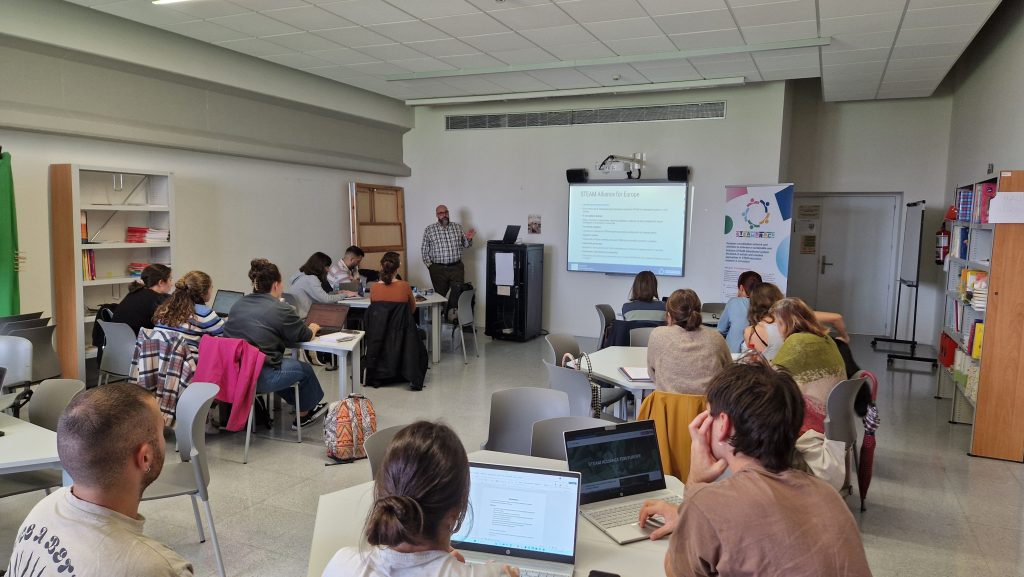
October 17, 2024 A rainy day in Bilbao received the members of Academia de Inventores and Edelvives for a meeting with the City Council of Bilbao to learn about the STEAM Education projects that they have. The meeting took place at La Perrera, the main STEAM center that the city has created. Its name comes from one of the old uses of that building, the dog shelter. This building, with 560 m2 in the city center had the “aspiration to become the reference space and equipment for the youth in Bilbao, besides offering other socio-cultural services to the city”. This is part of an “integran project of social innovation in youth politics in three different angles: information and counseling, emancipation and innovation”. This is meant for boys and girls aged 12 to 30, as a answer to the needs of the youth all over the different cycles of their life. It’s parto f the Konekta program, together with the Basque Government. However, this is just one of the 9 spaces of the city: Deusto, Castaños, Ramoni, Begoña, Esperantza, Abando, Basurto, Zorroza and La Perrera. They presented Bilbao’s STEAM initiative and the activities conducted across various centers. This initiative was largely implemented in collaboration with EHU, which has provided guidance for the maker lab and activities, for example. This is an excellent example of collaboration between two entities, as documented in this report. The meeting is with Javier Portillo, Urtza Garay, Arantzazu López de la Serna, Ainara Romero (EHU Universidad del País Vasco), and staff from the Bilbao City Council: Itxaso Erroteta Sagastagoya, Councilor of Youth and Sports from the Bilbao City Council, and Idoia Uriarte Ercilla, Director of Youth and Sports, and the technical managers of La Esperantza and La Perrera centers. From Academia de Inventores (ACINV), Sol Martire and Luis Martín and, finally, from Edelvives (EDE), Juancho Pons (STEAMbrace project coordinator). Bilbao City Council is very much involved in the STEAM Alliance for Europe that STEAMbrace is creating and will have a delegation traveling in February to the 1st STEAM Congress for stakeholders in Göteborg, Sweden, organized by WiTEC (European Association for Women in Science, Engineering & Technology, under the frame of STEAMbrace. After this first meeting, members of EHU, ACINV and EDE went to the Faculty of Education (Universidad del País Vasco EHU) for a meeting to set up the common ground for the STEAM activities in the different WPs and how it’ll work out for the case studies in the schools. Templates were established as the foundation for extracurricular activities (D3.7), handbook (D4.2), the Gothenburg Congress, and STEAM week. Issues regarding the congress in Zagreb (first annual meeting) and budget clarifications were also addressed. At the end, there was a short tour of the faculty facilities: Makerlab, classrooms and labs. Workshops by ACINV for students of the Master’s degree in Educational Technology the Universidad del País Vasco offers. The group consisted of three senior managers from Berritzegune Central (a center for training and educational innovation support in Euskadi), five experienced teachers, and eleven recent graduates in education, audiovisual communication, mathematics, and digital humanities. The workshops lasted for over 2 hours and they were a big success. At the same, we managed to promote the STEAM Alliance for Europe and the STEAM Congress, after an introduction of STEAMbrace. Since the students were mainly women, it was very valuable to see their opinion and reactions to the different project activities. Their insights were seen not only from the educational point of view but also from a gender perspective and that generated a very interesting debate.
The Future of Personalized Learning in STEAM Education

Personalized learning is revolutionizing STEAM education by tailoring educational experiences to meet the unique needs and interests of students. This approach shifts away from the one-size-fits-all model, allowing students to learn at their own pace and in their own style. Adaptive learning technologies, such as DreamBox and Khan Academy, are at the forefront of this movement. These platforms use sophisticated algorithms to adjust the difficulty of tasks based on student performance, providing personalized feedback and learning pathways that help students stay engaged and motivated. Summit Public Schools serve as a shining example of personalized learning’s potential. By implementing personalized learning plans, they have seen significant improvements in student engagement and outcomes. Each student at Summit has a personalized learning plan that includes specific goals and a tailored path to achieve them, supported by mentors and adaptive learning software. The school’s model also emphasizes the importance of mentoring, ensuring that each student receives the guidance and support they need to thrive. Educators worldwide are witnessing the transformative power of personalized learning. With increased motivation and better comprehension among students, personalized learning is proving to be a game-changer in STEAM education. Additionally, this approach addresses different learning styles and needs, helping to close achievement gaps and support students with diverse backgrounds and abilities. As technology continues to advance, the future of personalized learning looks bright, promising even more tailored and effective educational experiences for students. Emerging technologies like artificial intelligence and machine learning are expected to further enhance personalized learning by providing even more precise and responsive educational tools. These advancements will enable educators to create highly customized learning experiences that adapt in real-time to the needs and progress of each student.
Registration is now open for the STEAMBRACE Congress next February

Registration Open for the Future of STEAM Education Congress We are excited to announce that registration is now open for the Future of STEAM Education Congress, set to take place from February 3rd to 5th, 2025, in Gothenburg, Sweden. This event will bring together visionary educators, industry leaders, educational policy experts, cutting-edge researchers, and passionate students from across Europe to explore the latest trends in STEAM education. Participants will share best practices and forge collaborations that will shape the future of STEAM education in Europe. Focus on Diversity and Inclusion The congress will emphasize the promotion of diversity and inclusion in STEAM fields, with a special focus on enhancing female participation and supporting underrepresented groups. Attendees will contribute to significant discussions and initiatives aimed at transforming STEAM education into a more inclusive and impactful discipline. Event Highlights Over the course of three days, participants can look forward to a variety of inspiring and educational sessions, including: Invitation to Collaborate We invite institutions, organizations, individuals, and experts to share their knowledge and expertise with our audience. Participants are encouraged to register and express interest in various roles, including: We also welcome collaboration on untested ideas, with co-design workshops available to refine and develop these into effective activities or workshops. How to Register The registration is officially open. For detailed information about the STEAMBRACE project, eligibility criteria, and the registration process, please visit http://steambraceproject.eu/steam-congress-1/ Join us in shaping the future of STEAM education—register today!
Introducing STEAMBrace: Transforming STEAM Education in Europe
The STEAMBrace project is set to revolutionize STEAM education across Europe by fostering networking among stakeholders, providing comprehensive training, and establishing a cutting-edge digital framework. With a keen focus on gender balance, this 36-month initiative, funded by the Horizon Europe programme of the European Commission, aims to bridge the existing gender gap in STEM fields, advancing from secondary to doctoral education levels. Addressing Gender Disparity in STEM Despite women constituting over half of the European population, they represent only 40% of STEM professionals. This disparity is even more stark in the realm of innovation, where women account for a mere 10.7% of patent submissions. Recognizing this issue, STEAMBrace places a strong emphasis on gender balance, aligning with the European Commission’s policies aimed at achieving a gender-balanced research workforce by 2030. A Collaborative and Holistic Approach STEAMBrace’s strategy involves a multi-stakeholder approach to understand the gaps and limitations in STEM education across various demographics, including age, gender, and socio-cultural aspects. The project aims to foster a sustainable, inclusive, and reproducible STEAM education system that will drive cultural and social cohesion in Europe. By integrating transversal competencies such as arts, creativity, and innovation with traditional STEM subjects, STEAMBrace adopts an interdisciplinary STEAM (Science, Technology, Engineering, Art, Math) approach. This method has the potential to reshape STEM education, engage a broader range of students, and address the persistent gender gap within these fields. Empowering the Next Generation “The European children will be the centre of STEAMBrace,” says Juancho Pons, the project’s coordinator. “They will test all the activities and processes, participate in national and European contests, and lead a new generation of boys and girls in equal and balanced terms, spearheading the 21st-century revolution in education.” Looking Ahead As education systems increasingly adopt the STEAM approach, we can anticipate a more inclusive, diverse, and gender-balanced European future in the realms of science, technology, engineering, arts, and mathematics. “STEAMbrace is going to create and test activities and new processes that will take us to a higher level and to a STEAM certificate that can be accepted and approved by the European education community,” states Pons.